
Tactical biometric identification for public security
A tool that identifies persons of interest during field operations.
TOFIND identifies people in the field, with or without an internet connection. Every result is an indication that the identified person* has a very high probability of appearing in a public security database. *Every identification must always be subject to forensic fingerprint confirmation.
Why Tofind
Every day, thousands of fugitives pass through police checkpoints undetected.
It is not a lack of policing. It is the gap between the volume of people stopped every day and the speed at which any human procedure, no matter how well trained, can check each one of them — and most fixed cameras today were built to search for fugitives, not for people who went missing.
TOFIND exists to cover exactly that gap: vector identification in the officer's pocket, on any road, with or without a connection, without relying on manual typing or a fixed camera.
Equip police forces with technological innovation, AI and data analysis, providing information and intelligence to make police action faster, safer and more precise.
To be the most efficient and secure biometric identification and police intelligence platform in the country.
Values
Legal certainty
Decisions are supported by high-precision vector-based tools, but field action is always the officer's decision, and scientific confirmation of identity always belongs to forensic experts.
Information security
The custody, maintenance, creation and modification of the information in the databases used by the tool are the government's sole responsibility and control.
Full auditability
Every function performed in the system, from the officer's app to the server that provides the services, is auditable and protected by cryptographic chain-of-custody technology.
Missing Persons
Finding someone who vanished is just as urgent as catching someone on the run.
A missing-person case is not a crime. Because of that, it rarely opens a formal police inquiry, and rarely enters the same databases that feed fixed facial-recognition cameras — built to search for fugitives, not for people who went missing. TOFIND was designed to cover that gap, with a tool that fits in an officer's pocket at any point of contact.
Source: Brazil's Ministry of Justice and Public Security (MJSP), 2021–Apr/2025 data. Five states did not submit complete 2025 data — real figures may be higher.
Where field identification makes a difference
Unlike a fixed police checkpoint, a disappearance has no set time or place. TOFIND works wherever an officer is stationed — without depending on a pre-installed camera.
Human trafficking: sexual exploitation is now the leading purpose recorded in Brazil
Human trafficking in Brazil recorded a 33% increase in victims between 2024 and 2025, with sexual exploitation as the leading purpose — including 3,651 mapped points on federal highways, mostly at gas stations.
Sources: National Report on Human Trafficking (MJSP/UNODC, 2026); Asbrad/PRF/Childhood Brasil.
It is exactly at these points — bus terminals, highway stops, transit checks — that an offline tool, loadable with a missing-persons watchlist, turns a routine check into a real chance of finding someone.
How does the identification system work?
The two operating modes of the TOFIND algorithm
I — Online identification
- Real-time transmission — the local device captures the image and the GPS coordinates of the person, instantly sending the data to the central server.
- Pre-validation and quality filter — before heavy processing, the local system runs a quick check for quality and obvious inconsistencies, optimizing bandwidth use.
- Central qualitative assessment — on the server, the AI engine runs a visual similarity analysis to confirm the face and discard visibly incorrect candidates.
- Biometric validation (cosine, 512-d) — the algorithm measures the cosine distance between the 512-dimension vector of the captured photo and the registered vector, producing the final verdict.
- Audited record and verdict — after confirmation, the result is sent to the device and an immutable cryptographic hash (SHA-256) is generated and logged in the audit chain.
II — Offline identification
- Preload (Watchlist Sync Model) — the system syncs a restricted sub-database, defined by the agency as a priority: wanted individuals and/or missing persons.
- Local comparison — the detected face is processed by the local model, which generates a numeric vector representing the face, without saving the raw image.
- Protected queue — the result stays encrypted on the device itself, awaiting a network connection for final reconciliation.
- Reconciliation — as soon as the device detects a signal, the system syncs these records with the server, retroactively updating the audit chain.
ArcFace architecture — the same one that already topped the industry's most respected ranking
TOFIND Sentinel is built on ArcFace architecture. An implementation of this architecture achieved 1st place on the VISA track of NIST FRTE (Face Recognition Technology Evaluation, the industry's most respected ongoing benchmark, used by governments, border agencies and police forces worldwide), in October 2021.
How TOFIND compares two faces
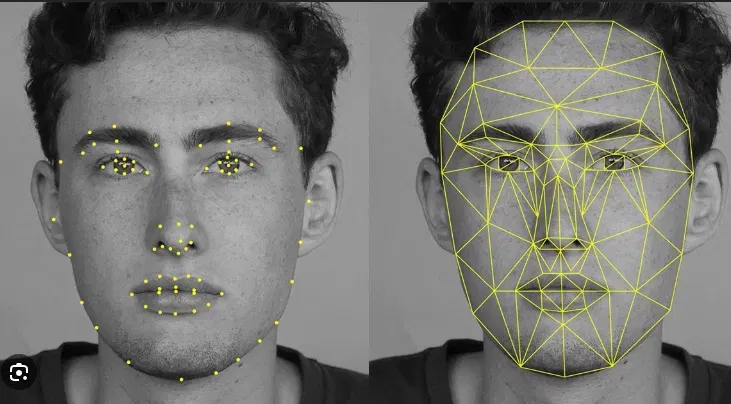
Each face becomes a vector of 512 numbers. Comparing two faces means measuring the angle between these vectors: the smaller the angle θ, the higher the probability of being the same person. It's this "angular margin" — which gives ArcFace its name — that makes the comparison more robust to lighting and pose variation.
TOFIND MISP — connects to any legacy database
Every state keeps its data differently. MISP is the API that connects to any source database, processes and normalizes the data via AI, and delivers it ready for Sentinel — always pending human review before any activation.
Our Vision for the Future
From a field tool to an intelligence ecosystem that strengthens public security policy.
TOFIND is evolving beyond individual identification toward something bigger: a neural-network system built on aggregated, statistical data that helps public administrators understand patterns, allocate resources based on evidence, and measure real outcomes, putting AI to work for public security.
Patterns, not people
Where and when activity concentrates, with aggregated, anonymized data to guide public policy decisions in security and defense.
Evidence, not intuition
Real effectiveness metrics, match rates, response times, for decisions based on data, not guesswork.
Partnership, not product
A platform that grows together with government, moving from a field tool to a data-engineering platform.
This is the direction we are building toward. We are a company focused on serving the public with a professional, high-quality service that keeps pace with current technology.
Macro view of the ecosystem
TOFIND operates as a four-layer ecosystem — each layer solving a distinct problem, and feeding the next.
Information Security
Security and rigor are our top priority.
Every event generated by the system is recorded on a trail designed so that any later alteration is detectable, like an airplane's black box. The architecture was built from day one around the principles that Brazilian facial-recognition regulation has been consolidating: mandatory human confirmation before any identification counts as a decision.
For governments and public administrators
A proven path for innovation in public security.
Procuring cutting-edge technology for security forces does not have to be a slow or bureaucratic process. TOFIND was structured to be acquired in a way that is agile, transparent and fully compliant with Brazilian law.
More than a tool: supporting your agency's planning
The ecosystem's data layer (TOFIND Intelligence) directly supports public security policy planning — evidence-based diagnosis, resource allocation and outcome measurement, always with aggregated, anonymized patterns, never individual surveillance.
Two legal pathways for agile procurement (under Brazilian law)
Startup Legal Framework (CPSI)
Complementary Law No. 182/2021 — Brazil's Startup Legal FrameworkA shared-technology-risk model that requires no large upfront investment. Once TOFIND's field effectiveness is proven, the law allows a direct move to a supply contract of up to 24 months, renewable for another 24 (up to 4 years total) — with no new competitive bidding process required.
Emergency Contract
Brazil's New Procurement Law — Law No. 14,133/2021We meet all requirements for direct contracting of up to 1 year in emergency situations or imminent risk to public safety, ensuring immediate administrative agility with full legal backing for the authorizing official.
Schedule a real-world pilot test
So administrators can verify the platform's effectiveness before any financial commitment, we provide the structure for pilot tests anywhere in the country — entirely funded by TOFIND. We handle the full validation journey with your agency:
Sandbox design
We jointly plan a controlled test environment: ideal timeframe, success indicators and strategic locations in a real-world setting.
Field training
Specialized, hands-on, tactical training for the officers on the front line.
Command integration
Technical training for CIOSP operators or command-and-control centers, aligning biometric intelligence with central monitoring.
Legal & compliance note
Our architecture operates strictly under an On-Premise or Private Cloud model, fully complying with Brazil's LGPD (General Data Protection Law, similar to the EU's GDPR) as applied to public security. The government agency retains full custody and control of the data; TOFIND acts strictly as a processor, with a permanent, encrypted audit trail (SHA-256).
Team
A lean team, with administrative, technical and product expertise.
Rodolpho Gustavo Ramos
Founder & Product Architect- More than 30 years of experience in information technology
- Background in Computer Networking; exchange program at the University of Ottawa
- Postgraduate degree in Project Management
- ~10 years of experience in public administration, with national innovation awards
- Specialization in public procurement and contracting, from the government side
- Former Federal Agent at the Federal Penal Police
Lorenna Medeiros de Araújo
Co-Founder & CEO- More than 18 years of experience in business administration
- Architect
- Forensic expert in real estate appraisal and expertise
Contact
Let's talk.
Fill out the form, and our team will get back to you through an institutional channel. This form is intended for public security agencies and administrators — there is no end-user registration on this page.